A homogenizer solves this problem by breaking larger particles into extremely small and uniform sizes, creating a stable mixture with consistent texture and quality. Homogenizers are an essential part of industries such as food processing, dairy, pharmaceuticals, cosmetics, biotechnology, and chemical manufacturing.
At Woxn Packaging, we offer advanced processing solutions designed to help manufacturers improve product quality, consistency, and production efficiency. Understanding the homogenizer meaning, operating principle, applications, and benefits can help businesses select the right equipment for their production requirements.
Homogenizer Meaning
The homogenizer meaning refers to a machine that reduces the size of particles within a liquid mixture and distributes them evenly throughout the product. The process prevents separation and creates a uniform consistency.
A Homogenizer Machine is a high-pressure mechanical device that forces liquid through a narrow valve or gap at high speed. The intense pressure, turbulence, and impact break larger particles into microscopic sizes, creating a uniform mixture. Whether in dairy plants or pharmaceutical manufacturing facilities, homogenizers play a crucial role in ensuring product consistency.
Homogenizer Working Principle
The homogenizer working principle is based on the application of high pressure combined with intense mechanical forces.
The process generally follows these steps:
Step 1: Product Feeding
The liquid product enters the homogenizer through an inlet system.
Step 2: High-Pressure Generation
A powerful pump increases the pressure of the liquid, often reaching several hundred bars depending on the application.
Step 3: Passage Through Homogenizing Valve
The pressurized liquid passes through a narrow gap or homogenizing valve.
Step 4: Particle Breakdown
As the liquid moves through the restricted opening, particles experience:
- High velocity
- Turbulence
- Cavitation
- Shear forces
- Impact forces
These forces break larger particles into extremely fine and uniform sizes.
Step 5: Uniform Product Formation
The processed liquid exits the machine with improved stability, smoothness, and consistency.
The effectiveness of the homogenizer working principle makes it suitable for a wide range of industrial applications.
Also Read: What is the difference between Mayo Vs. Salad Dressing
Types of Homogenizers
Homogenizers are available in various designs to meet the specific requirements of different industries, including food processing, dairy, pharmaceuticals, cosmetics, and biotechnology. Below are the most commonly used types of homogenizers and their applications.
1. High-Pressure Homogenizers
High-pressure homogenizers are the most widely used machines in the dairy and food industries.
2. Ultrasonic Homogenizers
Ultrasonic homogenizers use high-frequency sound waves to generate cavitation bubbles within the liquid. When these bubbles collapse, they create intense energy that breaks particles apart.
3. Mechanical Homogenizers
Mechanical homogenizers use rotating blades, rotors, or stators to create shear forces that mix and disperse particles evenly throughout a liquid.
4. Two-Stage Homogenizers
A two-stage homogenizer performs homogenization in two separate phases. The first stage reduces particle size, while the second stage eliminates particle clusters and improves emulsion stability.
5. Vacuum Homogenizers
Vacuum homogenizers combine mixing and homogenization under vacuum conditions. This process prevents air bubbles from entering the product and improves texture quality.
6. Inline Homogenizers
Inline homogenizers are installed directly within the production line, allowing continuous processing without interrupting manufacturing operations.
7. Laboratory Homogenizers
Laboratory homogenizers are compact units designed for testing, product development, and small-scale production.
Homogenizer Diagram
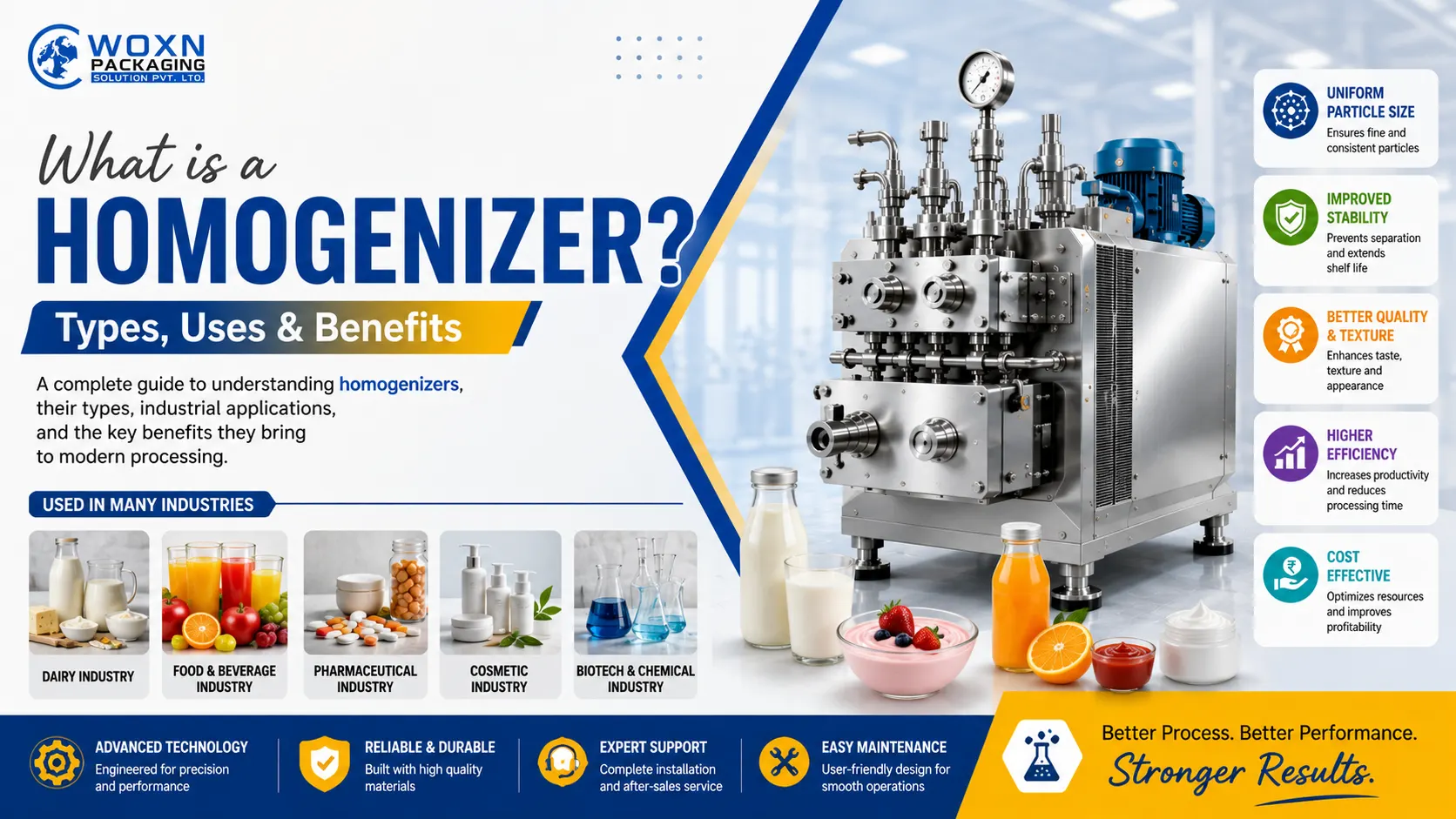
A basic homogenizer diagram typically consists of the following major components:
- Feed Tank: Stores the product before processing.
- High-Pressure Pump: Generates the pressure required for homogenization.
- Homogenizing Valve: The critical component where particle size reduction occurs.
- Pressure Gauge: Monitors system pressure during operation.
- Cooling System: Controls product temperature and prevents overheating.
- Product Outlet: Discharges the homogenized product for further processing or packaging.
A properly designed homogenizer diagram helps engineers and operators understand the flow path and functionality of the equipment.
Benefits of Using Homogenizers
Investing in high-quality homogenization equipment offers numerous advantages.
- Improved Product Consistency: Uniform particle distribution creates consistent quality across every batch.
- Enhanced Stability: Products remain mixed for longer periods without separation.
- Better Texture: Smooth texture improves consumer satisfaction and product appeal.
- Extended Shelf Life: Reduced particle size contributes to improved product stability during storage.
- Increased Production Efficiency: Automated systems improve processing speed and reduce manual intervention.
- Higher Product Quality: Fine particle distribution enhances appearance, taste, and functionality.
At Woxn Packaging, we provide reliable homogenization systems designed to maximize these benefits while maintaining operational efficiency.
Homogenizer Uses in Different Industries
Homogenizers play a crucial role in modern manufacturing by ensuring uniform particle size, improved product consistency, and enhanced stability. Homogenizer uses extend across multiple industries, helping manufacturers achieve higher product quality and production efficiency.
- Dairy Industry: Homogenizers break down fat globules into smaller particles, preventing cream separation and creating a smooth, uniform texture in milk, yogurt, cream, and flavored dairy beverages.
- Food & Beverage Industry: Food manufacturers use homogenizers to improve the consistency of products such as fruit juices, sauces, ketchup, mayonnaise, dressings, and ice cream.
- Pharmaceutical Industry: In pharmaceutical production, homogenizers are used to create stable emulsions, suspensions, vaccines, and injectable medicines.
- Cosmetic Industry: Homogenizers are essential for producing creams, lotions, shampoos, gels, and skincare products.
- Biotechnology & Chemical Industry: Biotechnology laboratories use homogenizers for cell disruption, protein extraction, and sample preparation.
These various homogenizer uses make homogenizers an indispensable piece of equipment in many industrial processing applications.
The ideal homogenizer depends on several factors, including product viscosity, required particle size, production capacity, and industry-specific requirements. Selecting the appropriate equipment ensures better product consistency, improved shelf life, and higher manufacturing efficiency. At Woxn Packaging, we provide high-performance homogenizers designed to meet the needs of food, dairy, pharmaceutical, cosmetic, and industrial processing applications. Our solutions help manufacturers achieve superior product quality while maintaining reliable and efficient production processes.